Staff Augmentation Process: A Practical Playbook
Master the staff augmentation process with a step-by-step playbook covering vendor selection, technical screening, compliance, onboarding, and performance


The most popular advice about staff augmentation is also the least useful: find a vendor, compare rates, review a few résumés, and start quickly. That approach treats engineering capacity like a commodity. In production, the harder questions appear after the contractor joins: who owns delivery, how will code quality be judged, what happens when AI-generated code reaches review, and which worker-classification rules apply across borders?
A reliable staff augmentation process is a governed operating model. It connects demand planning, technical screening, access control, delivery management, compliance, knowledge transfer, and offboarding. Speed still matters, but speed without controls creates rework, security exposure, and engagements that become difficult to unwind.
Table of Contents
Why Most Staff Augmentation Programs Underperform - Replace the requisition mindset - Govern the full engagement lifecycle
Selecting the Right Augmentation Partner - Test technical vetting depth - Examine bench strength and continuity - Look for operational green flags
Technical Screening in the Age of AI-Generated Code - Evaluate the review, not just the output - Use a production-shaped exercise
Onboarding Augmented Engineers for Rapid Productivity - Make the first two weeks intentional - Define integration rules
Navigating Compliance and Classification Risk Across Borders - Compare jurisdiction-specific requirements - Build controls into the workflow
Managing Performance and Planning Effective Exits - Create a feedback loop - Treat knowledge transfer as a deliverable - Decide on extensions and conversion deliberately
Deploy Top Engineering Talent with TekRecruiter
Why Most Staff Augmentation Programs Underperform
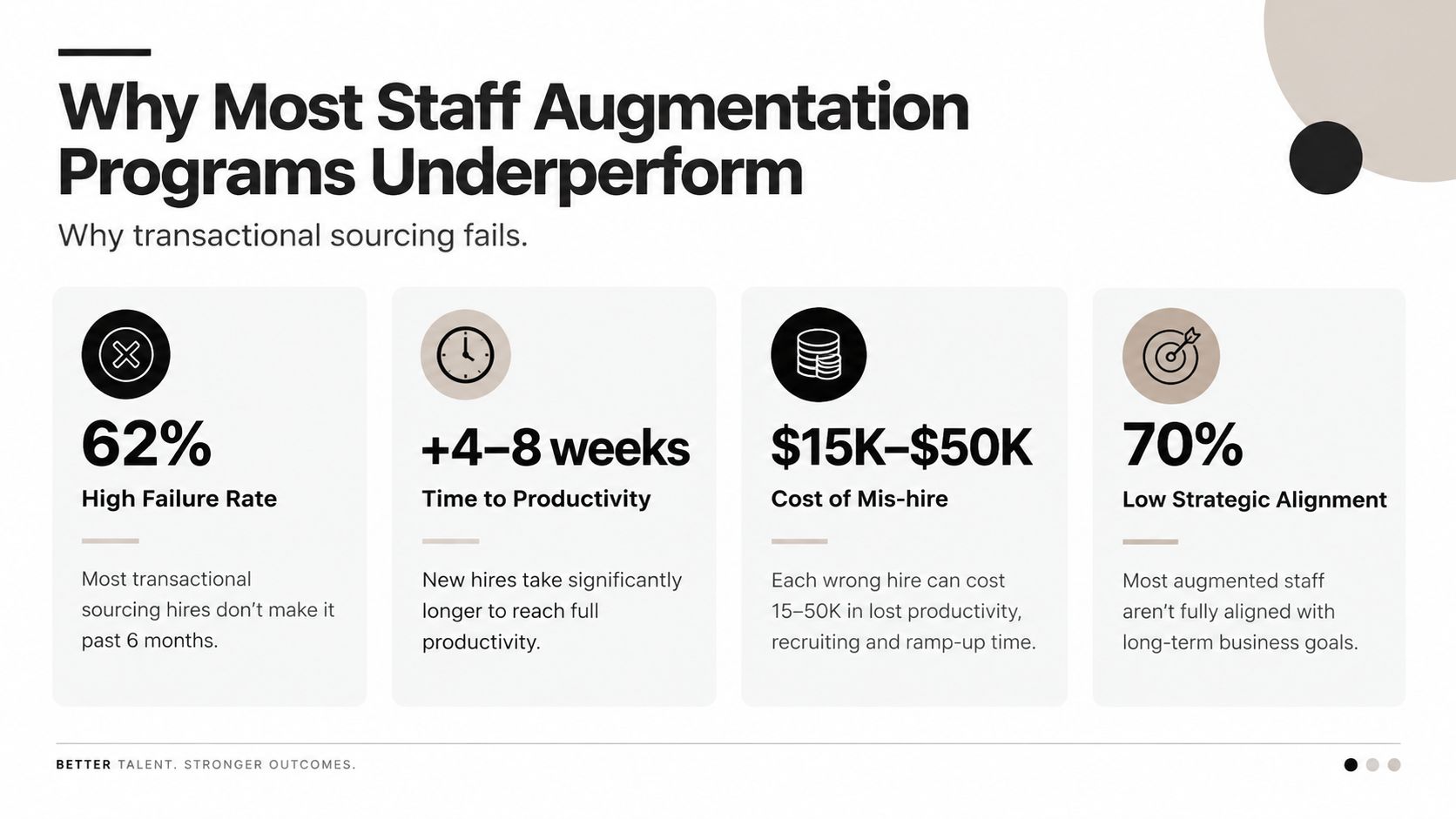
Staff augmentation underperforms when leaders define success as “someone started.” A requisition can be filled while the engineering team remains overloaded, the contractor lacks context, and finance has no dependable view of contingent labor commitments. The sourcing activity happened, but the operating process failed.
Benchmark data illustrates the gap. Average programs capture 38% of non-employee labor in budgeting, planning, and forecasting, while best-in-class programs capture 88%, according to the LevelUp Healthcare Solutions benchmark materials. That difference isn't an administrative footnote. If leadership can't see where contingent labor sits in the plan, it can't decide whether augmentation is solving a temporary capacity issue or masking a structural hiring problem.
The same benchmark reports 73% average total compliance, compared with 84% for best-in-class programs, and average year-over-year cost savings of 9.2%, compared with 12.4% for best-in-class programs. These figures point to a practical conclusion: governance isn't overhead added after sourcing. It's one of the mechanisms that improves financial control and compliance.
Replace the requisition mindset
Start with a capacity decision, not a job description. Define the product milestone, technical bottleneck, expected ownership, duration assumptions, reporting line, and internal counterpart before a vendor sees the request. A request for “a senior backend engineer” is weak. A request for an engineer who will own a bounded service migration, work within a named repository, participate in the client's review system, and transfer operational knowledge is actionable.
The process should also identify the approval path:
Engineering owner: Defines outcomes, technical scope, and acceptance criteria.
Finance partner: Confirms budget treatment and forecast visibility.
Security and legal: Reviews access, IP, privacy, and worker-classification requirements.
People or delivery operations: Tracks assignment status, performance, extensions, and exits.
Practical rule: If nobody owns the engagement after the contractor starts, the vendor becomes the de facto program manager, whether the contract says so or not.
Govern the full engagement lifecycle
A mature workflow uses a consistent record for demand intake, candidate evaluation, approval, onboarding, timesheets or deliverables, performance reviews, extensions, and offboarding. That record should make it easy to answer basic questions: which team is using the engineer, what work is assigned, who approved the extension, what systems remain accessible, and where knowledge was transferred?
Ad hoc sourcing fails because each engagement invents its own answers. A governed workflow creates repeatability without forcing every project into the same delivery model. The goal isn't bureaucracy. The goal is to make the risks visible early enough for leaders to act.
Selecting the Right Augmentation Partner
Price and speed are useful inputs, but neither tells you whether a partner can protect engineering quality. A vendor that sends résumés quickly may still lack the technical leadership, employment infrastructure, and replacement discipline required for a complex production environment.
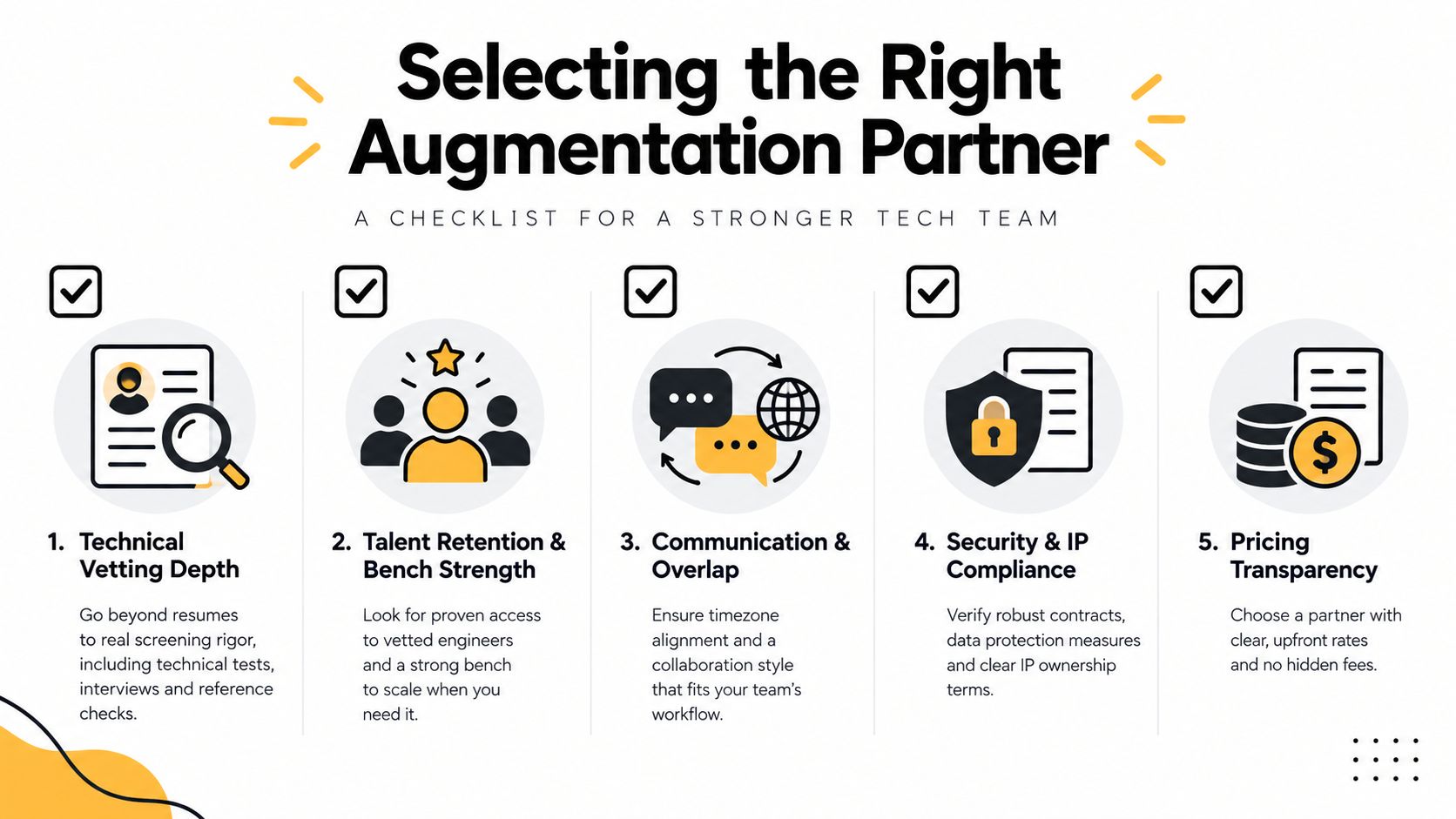
Use a scorecard that separates technical capability, operational control, and commercial clarity. Ask the vendor to show how a real request moves from intake to placement, not merely to describe its service in sales language.
Test technical vetting depth
Ask who conducts the technical evaluation, what evidence the evaluator reviews, and how the vendor distinguishes hands-on experience from résumé familiarity. Strong partners can explain how they assess architecture, debugging, testing discipline, operational judgment, and communication with peers.
You should also ask to meet the engineering leader responsible for quality. A red flag is a process built entirely around keyword matching, generic coding quizzes, and a promise that the client will perform the “real” evaluation after placement. That shifts the most expensive part of the selection process onto your team.
For a more detailed internal framework, use TekRecruiter's vendor selection criteria as a reference point, then adapt the criteria to your architecture and risk profile.
Examine bench strength and continuity
A partner's talent pool matters less than its ability to produce relevant, already-vetted candidates for your specific stack. Ask how it handles replacement, absence, performance concerns, and sudden changes in project demand. Request evidence of structured handoffs rather than accepting “we have access to thousands of engineers” as proof of delivery capacity.
The commercial model deserves the same scrutiny. Rates should identify what's included, how expenses are handled, how extensions work, and what happens if the match fails. For broader context on evaluating outsourced operational relationships, the Allied Tax Advisors outsourcing guide offers useful questions around scope, accountability, and vendor oversight.
Look for operational green flags
A credible partner will discuss security controls, IP assignment, background verification, time-zone overlap, communication expectations, and offboarding before you ask. It won't resist a client-side interview, but it also won't pretend that a résumé review is a technical assessment.
Be cautious when the vendor:
Optimizes for volume: It measures success mainly by the number of profiles delivered.
Avoids ownership questions: It can't explain who manages quality or replacement decisions.
Hides pricing mechanics: It presents a low headline rate but gives no clear treatment of fees or transitions.
Treats compliance as universal: It uses one contract and one classification approach for every country.
The right partner behaves like an extension of your engineering operations, not a résumé delivery inbox.
Technical Screening in the Age of AI-Generated Code
A candidate who can produce code isn't automatically able to approve code. AI tools can generate plausible implementations quickly, but production safety depends on whether an engineer can inspect assumptions, identify missing tests, challenge an unsafe abstraction, and understand how a change behaves under real operating conditions.
Recent coverage of staff augmentation trends and screening challenges describes this shift from basic coding ability toward AI-review judgment. The practical implication for CTOs is significant. Traditional résumé screening and quiz-based evaluation can reveal syntax familiarity, but they're weaker signals for reviewing machine-produced work.

Evaluate the review, not just the output
Give the candidate a small, realistic code sample containing intentional problems. The sample might include weak error handling, an incomplete authorization check, an inefficient database query, an untested edge case, or a misleading function boundary. Ask the engineer to review it as if it came from an automated coding assistant.
Watch the reasoning. Does the candidate identify risk before style? Do they ask what the code is supposed to guarantee? Can they propose tests that would fail under the suspected defect? Strong reviewers explain uncertainty and prioritize remediation rather than rewriting everything to demonstrate personal preferences.
A useful interview should include engineer-to-engineer discussion about:
Assumptions: What must be true for the implementation to work?
Failure modes: How could the change fail in production?
Observability: What logs, metrics, or traces would expose the problem?
Security: Which inputs, identities, permissions, or secrets need protection?
Maintainability: Can another engineer safely modify the code later?
The structured interview process can help interviewers assess candidates consistently, provided the rubric reflects your actual system risks.
Use a production-shaped exercise
Avoid making the exercise a race. Raw coding speed is less valuable than careful judgment when engineers work alongside code-generation tools. Give candidates enough context to explain trade-offs, then ask them to defend a review decision and describe what they'd verify before merge.
The interview should also test collaboration. A contractor may need to tell a product manager that an AI-generated implementation is unsafe, ask a staff engineer to clarify an invariant, or recommend reducing scope. Those conversations reveal whether the person can operate inside a team's quality system instead of acting as an isolated code producer.
The video below can supplement a written rubric by prompting discussion about how engineers reason through technical work and communication.
Onboarding Augmented Engineers for Rapid Productivity
A Slack invitation and repository permission aren't an onboarding plan. An augmented engineer needs enough product, architecture, security, and team context to make safe decisions without repeatedly interrupting the people the engagement was meant to support.
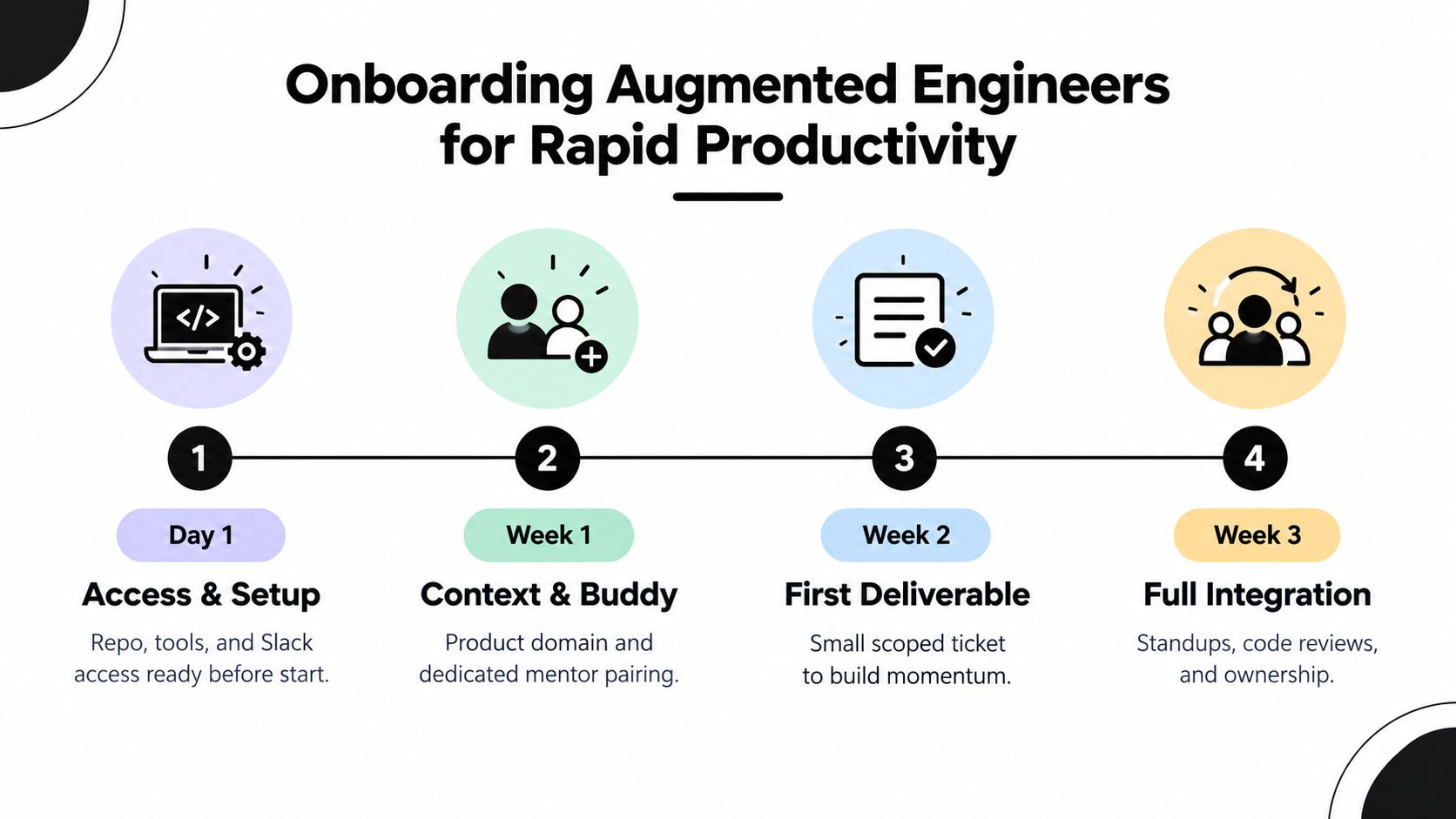
Prepare access before the start date. Create the accounts, confirm the development environment, document the repository structure, identify required approvals, and assign a named technical buddy. Access should follow least-privilege principles, with an explicit owner for granting and removing each permission.
Make the first two weeks intentional
The first day should remove setup friction. The engineer needs working tools, repository access, build instructions, communication channels, issue-tracking permissions, and a clear explanation of how work reaches production.
During the first week, focus on context rather than maximum output. Pair the engineer with someone who can explain domain terminology, service boundaries, deployment habits, incident history, and unwritten team norms. Give the new contributor a small change to run through the entire path, from local development to review and deployment.
By the second week, the engineer should own a bounded deliverable. The task should be meaningful enough to reveal understanding, but contained enough that the client can review the work closely. A missed milestone at this stage is useful information. It may indicate unclear requirements, insufficient access, a skill mismatch, or weak support.
Define integration rules
Write down who approves code, who handles incidents, where design decisions live, and how disagreements get resolved. Don't make the contractor infer these rules from scattered conversations.
A practical onboarding checklist includes:
Access validation: Confirm every required system works and every unnecessary permission is absent.
Architecture orientation: Explain the critical paths, dependencies, and known constraints.
Communication rhythm: Set standups, pairing time, review expectations, and escalation routes.
First deliverable: Assign a scoped ticket with explicit acceptance criteria.
Feedback checkpoint: Review progress early enough to correct the engagement without waiting for a formal performance problem.
For additional guidance on making this sequence repeatable, see TekRecruiter's best practices for onboarding. Good onboarding doesn't just accelerate delivery. It creates the evidence leaders need to decide whether the engagement is viable.
Navigating Compliance and Classification Risk Across Borders
Cross-border augmentation changes the risk calculation. The cheapest sourcing route may create exposure around worker classification, IP ownership, supervision, equal treatment, payroll, or assignment duration. Those issues belong in intake and contract review, not in an emergency conversation after a local manager wants to extend a contractor.
One industry analysis cites an 11.4% classification dispute rate for buyers using direct 1099 contractor relationships without provider intermediation, compared with 0.3% for buyers using owned-entity EOR providers. The same analysis identifies IP exposure, knowledge-transfer gaps, and vendor concentration as practical risks in staff augmentation risk and mitigation guidance. Treat those figures as a warning about model selection, not as a universal prediction for every engagement.
Compare jurisdiction-specific requirements
Jurisdiction | Key Regulation | Duration Limit | Worker Rights |
|---|---|---|---|
European Union | Temporary agency worker protections | Depends on member-state implementation and assignment structure | The user company should inform temporary agency workers about permanent vacancies, and member states must nullify clauses that block direct employment or contract relationships with the user undertaking. |
United Kingdom | Agency Workers Regulations 2010 | A 12-week qualifying period applies before equal treatment in certain employment conditions. UK legislation | An agency worker has a contract with the temporary work agency but works temporarily under the hirer's direction and supervision. |
Poland | Temporary agency work rules | Assignment must not exceed 18 months within 36 consecutive months. Polish temporary agency guidance | The agency and client need cumulative assignment tracking across repeated engagements. |
Canada | Temporary help agency model | Terms vary by arrangement and jurisdiction | Federal guidance describes temporary help agencies as providing qualified workers to businesses temporarily under adaptable terms. Canadian-linked legislative guidance |
The EU rule on permanent vacancies matters when a contractor becomes embedded in the client organization. Conversion planning can't rely only on informal policy. Likewise, UK assignment tracking must account for the qualifying period, while Poland requires cumulative duration monitoring across repeated assignments.
Build controls into the workflow
Your intake form should record the worker's country, employing entity, work location, supervision model, assignment start, expected end, extension authority, and conversion path. Legal counsel should confirm the applicable model, especially for regulated work, sensitive data, or direct contractor relationships.
A practical background verification process should align with local law and the role's access requirements. For broader operational context, tips for HR compliance outsourcing can help teams think through ownership, documentation, and vendor oversight.
Managing Performance and Planning Effective Exits
Performance management should begin with the statement of work. “Support the platform team” doesn't give anyone a reliable basis for deciding whether the engagement is working. Define the deliverable, technical boundaries, review responsibilities, expected collaboration, and evidence of completion.
Use measures that reflect engineering outcomes rather than activity alone. Completed work should meet acceptance criteria, pass the team's review standards, preserve security and reliability expectations, and leave enough documentation for another engineer to operate it. Lines of code, hours online, and meeting attendance can provide context, but they shouldn't substitute for delivery quality.
Create a feedback loop
Set an early check-in between the engineering manager, technical owner, vendor contact, and contractor. Discuss delivery, communication, blockers, code-review feedback, and scope changes. If performance concerns arise, document the specific behavior and the correction expected.
The vendor should know what support it must provide. A replacement clause is useful only if the client can invoke it without ambiguity, and a client should avoid waiting until a failed release makes the decision urgent.
A good exit plan is a delivery control. It forces the team to preserve knowledge before the person becomes unavailable.
Treat knowledge transfer as a deliverable
Require practical handoff material, not a final paragraph in a ticket. Depending on the work, that may include architecture decisions, deployment procedures, troubleshooting notes, test coverage gaps, ownership boundaries, and a walkthrough with the internal successor.
Offboarding should remove access in a coordinated sequence, recover equipment where applicable, close accounts, confirm repository ownership, review open work, and preserve relevant communication or documentation. Assign one person to certify completion. Otherwise, every team assumes another team handled it.
Decide on extensions and conversion deliberately
An extension should answer a business question. Is the work still temporary? Has the scope changed? Does the team need a permanent role? Is the engineer's knowledge now critical enough to require a succession plan?
Conversion can be valuable, but internal job access and worker rights vary by jurisdiction. In the EU, temporary agency workers should be informed about permanent vacancies, and member states must nullify clauses that obstruct direct employment or contracting relationships with the user undertaking, as described in the EU temporary agency worker rights guidance. Legal review should precede any conversion or restrictive clause.
Deploy Top Engineering Talent with TekRecruiter
A dependable augmentation program needs more than access to contractors. It needs a partner that can understand the technical request, test judgment, support the engagement, and work within the client's governance model.
TekRecruiter uses an engineer-to-engineer recruiting model, replacing superficial résumé and quiz screening with deep technical conversations. Its focus includes software engineering, AI engineering, DevOps, SRE, platform, cloud, systems, data, Salesforce, ERP, and cybersecurity engineering. That model fits teams that need to evaluate architecture reasoning, production judgment, and the ability to review AI-generated code, not just produce a short coding exercise.
TekRecruiter provides direct hire, staff augmentation, on-demand access to a 30,000+ pre-vetted engineer bench, and managed services. For a staff augmentation engagement, the client can retain day-to-day technical management while using the partner to support sourcing and talent delivery. The governance still belongs on both sides: define scope, access, compliance ownership, review standards, performance checkpoints, and the exit path before work begins.
CTOs, VPs of Engineering, IT directors, and program leaders should bring a concrete problem to the first conversation. Share the role, stack, location requirements, delivery pressure, security constraints, and expected engagement shape. A useful partner can then assess whether augmentation is appropriate and what controls the process requires.
TekRecruiter provides technology staffing, recruiting, AI engineering, and staff augmentation services for companies that need top engineering talent anywhere in the world. Visit TekRecruiter to discuss your team's technical requirements, screening standards, and cross-border delivery needs with a recruiting partner built around engineer-to-engineer evaluation.